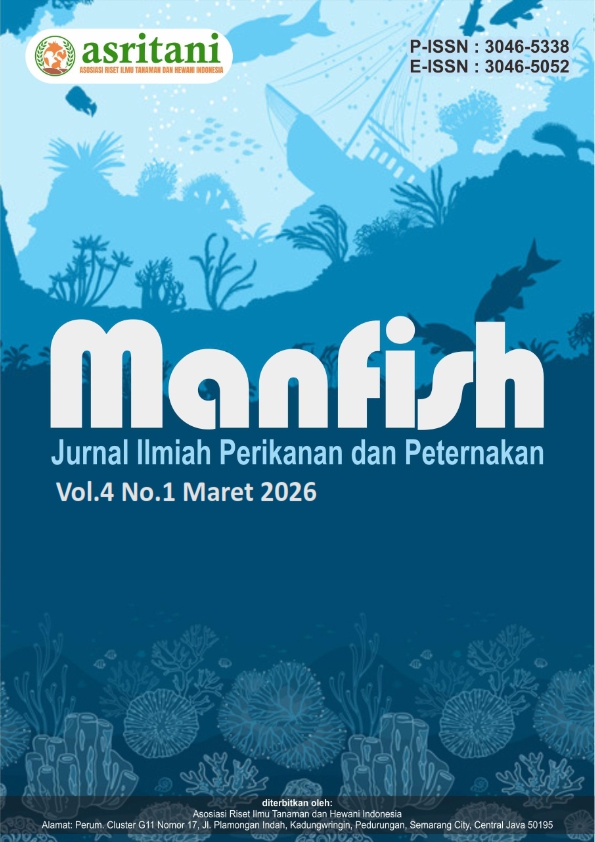
Pengaruh Dosis Probiotik Pro Top Terhadap Laju Pertumbuhan Ikan Nila (Oreochromis Niloticus) pada Sistem Bioflok di Minadesa Fishfarm
DOI:
https://doi.org/10.62951/manfish.v4i1.332Keywords:
Biofloc System, Biofloc, Nile Tilapia, Probiotics, Water QualityAbstract
Biofloc technology is a super-intensive fish cultivation method, which benefits heterotrophic bacteria to harvest organic chemical compounds and amines from fish metabolic residues to be converted into bacterial proteins. The use of probiotics is very important to be carried out in cultivation activities, Probiotics are living microorganisms that have a beneficial effect on humans by balancing the microflora in their intestines. The bacteria in probiotics have a mechanism in forming several enzymes for feed digestion. This study aims to determine the effect of administering Pro Top probiotics with different doses on the absolute weight growth of tilapia (Oreochromis niloticus). Probiotics are mixed with feed with a biofloc cultivation system. The method used in this study is an experimental method with a Completely Randomized Design (CRD) with 4 treatments and 6 replications, namely by adding different doses to the treatment. Treatment A (0.5 grams / kg), B (1 gram / kg), C (2 grams / kg) and D (5 grams / kg). The parameters observed are absolute weight growth. Supporting parameters for air quality are temperature, pH, and DO. Data were analyzed using the ANOVA test. Based on the results of the study, it shows that administering different doses of Pro Top probiotics has a significant effect on the absolute weight growth of tilapia (Oreochromis niloticus). Treatment A (0.5 grams/kg) gave the lowest absolute weight growth of 31.05 grams and treatment D (5 grams/kg) gave the highest absolute weight growth of 40.30 grams. Air quality parameters including air temperature ranged from 25.3 – 26.1°C, acidity level around 7.5 – 8.0. And dissolved oxygen ranged from 4.7 – 5.3 ppm. The results of the analysis of variance (ANOVA) of the three air quality parameters showed no difference between the treatments of tilapia (Oreochromis niloticus).
References
Ahmadi, H., Iskandar, & Kurniawati, N. (2012). Pemberian probiotik dalam pakan terhadap pertumbuhan lele Sangkuriang (Clarias gariepenus) pada pendederan II. Jurnal Perikanan dan Kelautan, 3(4), 99–107.
Akbar, F., Ma’shum, M., & Setyowati, D. N. (2013). Pengaruh pemberian probiotik EM4 dengan dosis berbeda terhadap kelangsungan hidup larva ikan badut (Amphiprion percula). Jurnal Perikanan Unram, 1(2), 60–69.
Aliyas, Ndobe, S., & Ya’la, Z. R. (2016). Pertumbuhan dan kelangsungan hidup ikan nila (Oreochromis sp.) yang dipelihara pada media bersalinitas. Jurnal Sains dan Teknologi Tadulako, 5(1), 19–27.
Amri, K. (2021). Penggunaan probiotik pada wadah pemeliharaan benih ikan nila (Oreochromis niloticus) sebagai pengendali kualitas air. Jurnal Ilmiah Program Studi Perairan. https://doi.org/10.51179/jipsbp.v3i2.668
Amri, K., & Khairuman. (2013). Budidaya ikan nila. PT Agro Media Pustaka.
Azhar, F. (2013). Pengaruh pemberian probiotik dan prebiotik terhadap performa juvenil ikan kerapu bebek (Comileptes altivelis). Buletin Veteriner Udayana, 6(1), 1–9.
Azhari, D., Mose, N. I., & Tomasoa, A. M. (2018). Kajian kualitas air (suhu, DO, pH, amonia, nitrat) pada sistem akuaponik untuk budidaya ikan nila (Oreochromis niloticus). Jurnal Ilmiah Tindalung, 4(1), 23–26.
Fujaya, Y. (2008). Fisiologi ikan: Dasar pengembang teknik perikanan. PT Asdi Mahastya.
Kementerian Kelautan dan Perikanan. (2010). Teknologi pembenihan ikan patin (Pangasius sp.) yang dipelihara secara outdoor di kolam yang dipupuk. Badan Penelitian dan Pengembangan Kelautan Perikanan.
Khotimah, K., Harmilia, E. D., & Sari, R. (2016). Pemberian probiotik pada media pemeliharaan benih ikan patin (Pangasius hypophthalmus) dalam akuarium. Jurnal Akuakultur Rawa Indonesia, 4(2), 152–158.
Mengistu, S. B., Mulder, H. A., Benzie, J. A. H., & Komen, H. (2020). A systematic literature review of the major factors causing yield gap by affecting growth, feed conversion ratio and survival in Nile tilapia (Oreochromis niloticus). Reviews in Aquaculture, 12(1), 524–541. https://doi.org/10.1111/raq.12331
Robertson, P. A. W., O’Dowd, C., Burrells, C., Williams, P., & Austin, B. (2000). Use of Carnobacterium sp. as a probiotic for Atlantic salmon (Salmo salar L.) and rainbow trout (Oncorhynchus mykiss). Aquaculture, 185, 235–243. https://doi.org/10.1016/S0044-8486(99)00349-X
SNI 7550:2009. (2009). Produksi ikan nila (Oreochromis niloticus Bleeker) kelas pembesaran di kolam air tenang. Badan Standardisasi Nasional.
Sumule, J. F., Tobigo, D. T., & Rusaini. (2017). Aplikasi probiotik pada media pemeliharaan terhadap pertumbuhan dan sintasan ikan nila merah (Oreochromis sp.). Jurnal Agribisnis.
Tuan, T. N., Duc, P. M., & Hatai, K. (2013). Overview of the use of probiotics in aquaculture. International Journal of Research in Fisheries and Aquaculture, 3(3), 89–97.
Wijayanti, M., Khotimah, H., Sasanti, A. D., Dwinanti, S. H., & Rarassari, M. A. (2019). Pemeliharaan ikan nila (Oreochromis niloticus) dengan sistem akuaponik di Desa Karang Endah, Kecamatan Gelumbang, Kabupaten Muara Enim, Sumatra Selatan. Journal of Aquaculture and Fish Health, 8(3). https://doi.org/10.20473/jafh.v8i3.14901
Downloads
Published
How to Cite
Issue
Section
License
Copyright (c) 2026 Manfish: Jurnal Ilmiah Perikanan dan Peternakan

This work is licensed under a Creative Commons Attribution-ShareAlike 4.0 International License.